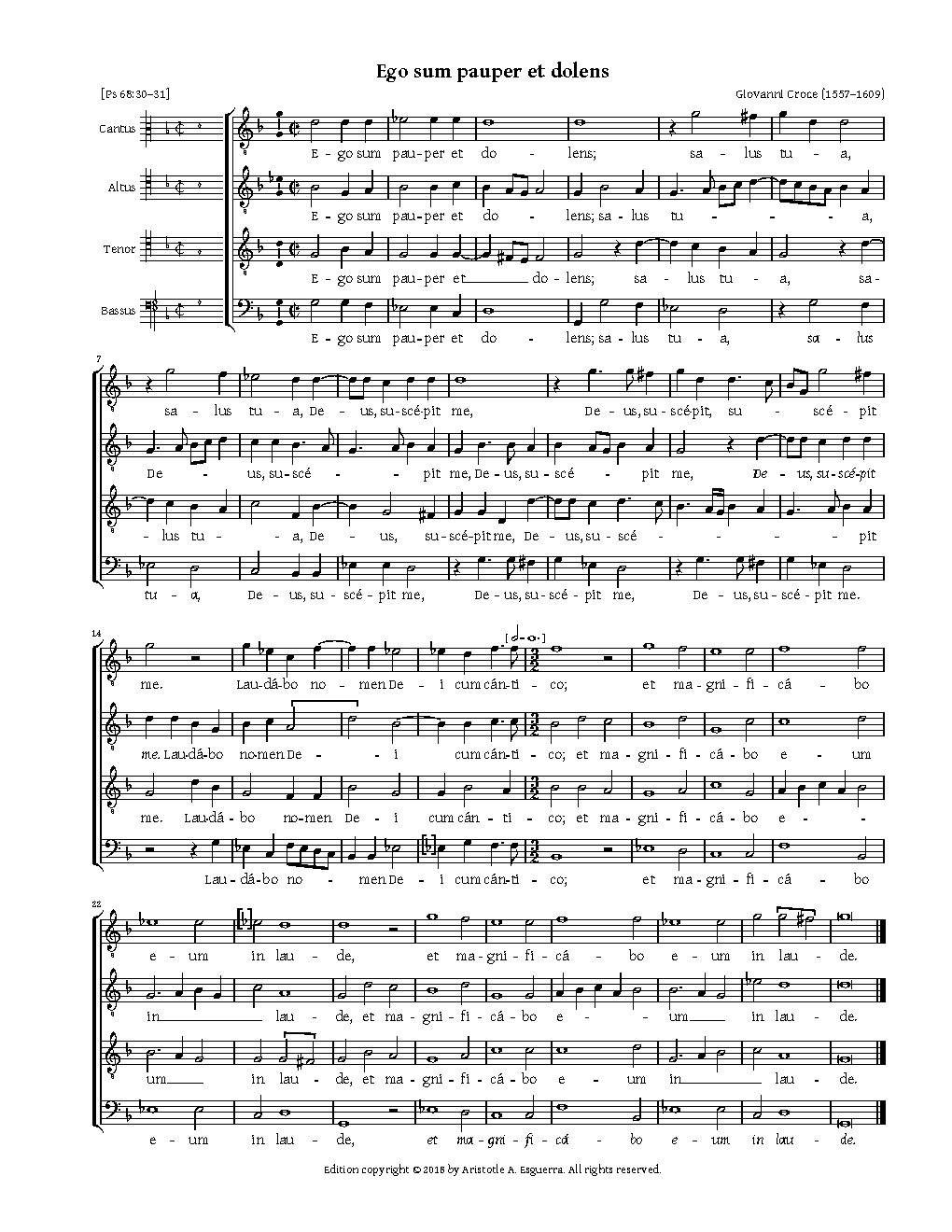
This edition was prepared by Aristotle Aure Esguerra — free to download, print, rehearse and perform.
Ego sum pauper
Staff Notation • Sacred, Motets
Preview
0
0
2 editions of this piece
Different typesettings and voicings of the same work. This page shows the main edition; the others are below.
ATTB, TTTB, TTBB · James Gibb
Preview
Subscribed as
Want Sunday picks sent to another address too?
Free weekly email
Your choir should not be left out in what's trending
Sunday mass selections, psalms, and trending songs in your area — straight to your inbox.
Ego sum pauper by Giovanni Croce — Lyrics
mm
In finem, pro iis qui commutabuntur. David.
Salvum me fac, Deus,
quoniam intraverunt aquae usque ad animam meam.
Infixus sum in limo profundi et non est substantia.
Veni in altitudinem maris, et tempestas demersit me.
Laboravi clamans, raucae factae sunt fauces meae;
defecerunt oculi mei, dum spero in Deum meum.
Multiplicati sunt super capillos capitis mei qui oderunt me gratis.
Confortati sunt qui persecuti sunt me inimici mei injuste;
quae non rapui, tunc exsolvebam.
Deus, tu scis insipientiam meam;
et delicta mea a te non sunt abscondita.
Non erubescant in me qui exspectant te, Domine, Domine virtutum;
non confundantur super me qui quaerunt te, Deus Israël.
Quoniam propter te sustinui opprobrium;
operuit confusio faciem meam.
Extraneus factus sum fratribus meis,
et peregrinus filiis matris meae.
Quoniam zelus domus tuae comedit me,
et opprobria exprobrantium tibi ceciderunt super me.
Et operui in jejunio animam meam,
et factum est in opprobrium mihi.
Et posui vestimentum meum cilicium;
Read full lyrics
About Ego sum pauper
Giovanni Croce's motet Ego sum pauper is a powerful setting of a deeply personal psalm of distress and supplication. Likely intended for a service of lamentation or penitence, its Latin text expresses a profound sense of being overwhelmed and abandoned, crying out for divine intervention. The composer masterfully crafts this emotional narrative through his characteristic Venetian polyphony. Employing a rich texture, Croce utilizes a variety of vocal combinations, shifting between ATTB, TTTB, and TTBB configurations. This dynamic approach allows for both intimate moments and grand pronouncements, mirroring the ebb and flow of the text's plea for rescue and steadfast hope in God.