This edition was prepared by Claudio Macchi — free to download, print, rehearse and perform.
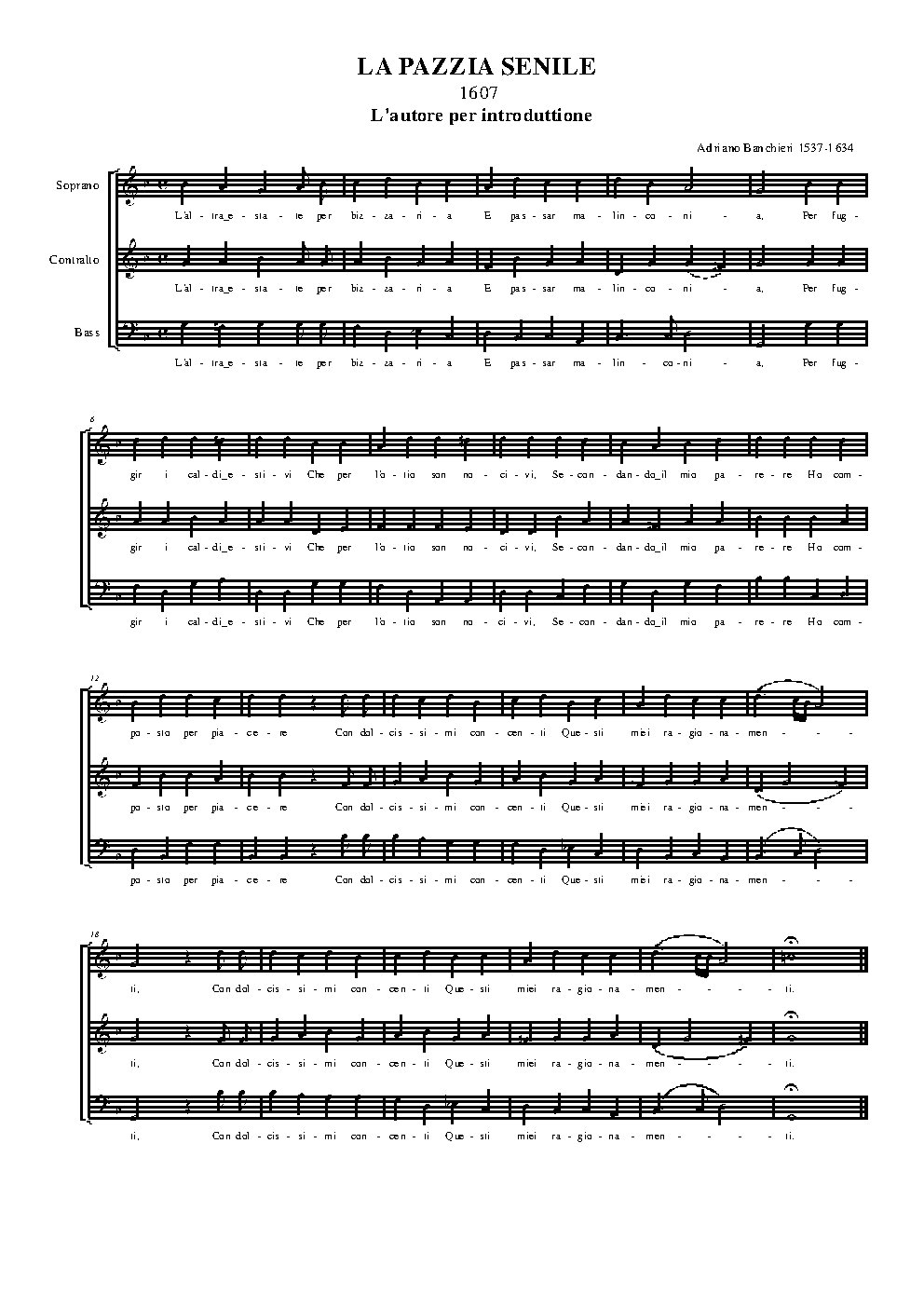
La Pazzia Senile
Staff Notation • Secular, Madrigals
Preview
0
0
21 editions of this piece
Different typesettings and voicings of the same work. This page shows the main edition; the others are below.
Edition · Claudio Macchi
Preview
Edition · Claudio Macchi
Preview
Edition · Claudio Macchi
Preview
Edition · Claudio Macchi
Preview
Edition · Claudio Macchi
Preview
Edition · Claudio Macchi
Preview
Edition · Claudio Macchi
Preview
Edition · Claudio Macchi
Preview
Edition · Claudio Macchi
Preview
Edition · Claudio Macchi
Preview
Edition · Claudio Macchi
Preview
Edition · Claudio Macchi
Preview
Edition · Claudio Macchi
Preview
Edition · Sabine Cassola
Preview
Edition · Claudio Macchi
Preview
Edition · Claudio Macchi
Preview
Edition · Claudio Macchi
Preview
Edition · Claudio Macchi
Preview
Edition · Claudio Macchi
Preview
Edition · Claudio Macchi
Preview
Subscribed as
Want Sunday picks sent to another address too?
Free weekly email
Your choir should not be left out in what's trending
Sunday mass selections, psalms, and trending songs in your area — straight to your inbox.
La Pazzia Senile by Adriano Banchieri — Lyrics
1. L’altra estate per bizzaria
E passar malinconia!
Per fuggir i caldi estivi
Che per l’otio son nocivi.
Secondando il mio parere
Ho composto per piacere
Con dolcissimi concenti
Questi miei ragionamenti.
2. Strazz’ e ciabatte, Donne ai solfanelli.
Sù, che non bianchi e belli
I mazzi grossi e i cannonzin sottili
Legati con buon fili
Il zolfo verde, e questo non è gioco
S’accenderan col fuoco:
Sù, che non bianchi e belli
Strazz’ e ciabatte, Donne ai solfanelli.
3. Illustri spettatori,
Qui son venuto fuori
Alla vostra presenza
Per farvi riverenza
S’apete voi ch’io sia?
Read full lyrics
About La Pazzia Senile
Adriano Banchieri was a prolific composer of the Italian Renaissance, known for his innovative madrigals. La Pazzia Senile (Old Age Madness) is a secular work that playfully explores various themes. The first section suggests a desire to escape the summer heat and boredom through music. The second section, with its vivid imagery of matches and sulfur, hints at a more boisterous and perhaps fiery sentiment. The final section, presented as a self-introduction, describes the composer as a 'bizarre humor' appearing before the audience to pay respects, adding a layer of witty self-awareness to the collection of madrigals. This collection showcases Banchieri's skill in setting Italian text with both wit and musical invention.